What is Eyebrow (Brow/Forehead) Lift Surgery
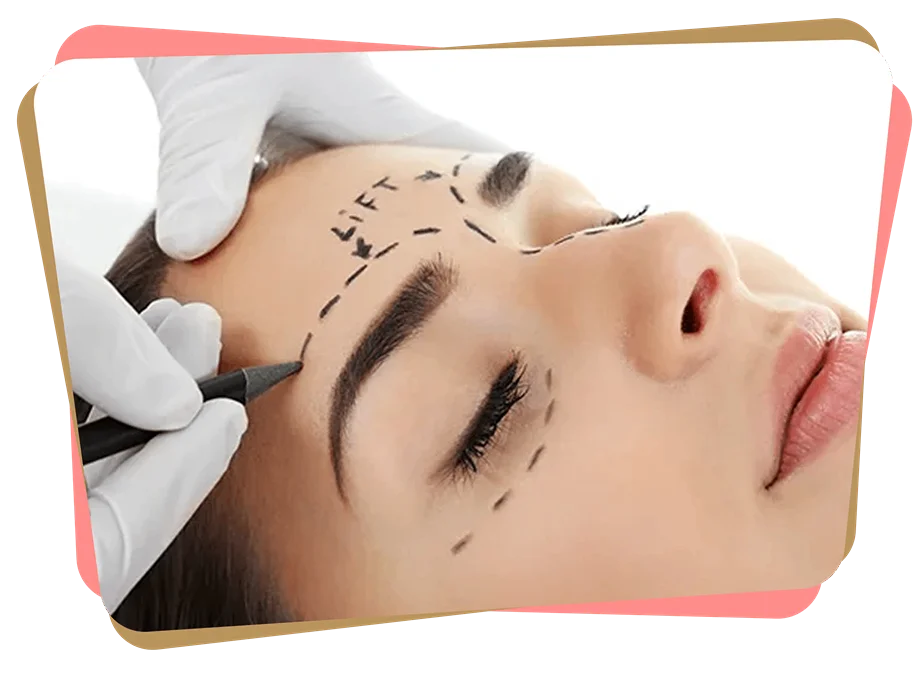
Table of Contents

An eyebrow lift (also called a brow lift, forehead lift, or browplasty) is a cosmetic procedure that raises drooping or sagging eyebrows and smooths forehead wrinkles. It repositions the forehead skin and underlying tissue to give a more open, youthful upper face.
The goal is to correct sagging brows, reduce horizontal forehead lines, vertical “frown lines” between brows (the “11’s”), and address a heavy-looking upper eyelid area caused by brow droop.
A brow lift does not change the shape of the eyes themselves nor directly remove excess eyelid skin. For droopy eyelids, a separate eyelid surgery (blepharoplasty) may be needed.
Techniques and Methods: Surgical and Non-Surgical Options
Surgical Techniques
Several surgical approaches exist. Choice depends on the patient’s anatomy, skin condition, amount of sagging, and aesthetic goals.
Endoscopic Brow Lift
- Several small incisions are made just behind the hairline. A thin camera (endoscope) and small instruments are inserted. The surgeon repositions the underlying forehead tissue and muscles. Brows are lifted and fixed in the new position.
- Advantages: minimal visible scarring, less tissue disruption, relatively faster recovery compared to older methods.
Temporal / Limited-Incision (Lateral) Brow Lift
- Incisions are placed near the temples/hairline. This lifts only the outer brow (lateral brow). Suitable for mild drooping or droop confined to the outer brow.
- Less invasive than a full open lift, but limited in how much it can lift (mainly outer brow).
Direct / Mid-Forehead Brow Lift
- Incision is placed just above the eyebrows. Excess skin/tissue removed; brow repositioned. More blunt, but it offers precise control of brow elevation.
- Usually reserved for patients with heavy brows or significant drooping. May leave a visible scar.
Coronal / Open (Classic) Brow Lift
- A long incision from ear to ear across the top of the scalp / along the hairline. Forehead skin lifted, excess removed, brow repositioned.
- Allows comprehensive lifting, including central brow and forehead. But there is a higher risk of visible scarring, hairline shift, or scalp sensitivity.
Surgeons decide on the technique based on factors such as the degree of sagging, forehead length, hairline, scalp mobility, and patient preference.
Non-Surgical and Minimally Invasive Alternatives
Not all eyebrow lifting requires surgical incisions. Some less invasive methods aim to lift the brow or smooth the forehead without cutting skin.
Common options:
- Injectables (e.g. neurotoxins like Botox or dermal fillers) to relax muscles around the brows/forehead and produce a subtle lifting effect.
- Thread-based lifts (suture lifts): special dissolvable threads placed under the skin to reposition soft tissue. Lower invasiveness than open surgery.
- Energy-based treatments (Ultrasound, Radiofrequency, Laser, High-intensity focused ultrasound, fractional radiofrequency, thermo-mechanical ablation): These aim to tighten the skin and stimulate collagen production, producing mild lift and smoothing.
These non-surgical methods offer shorter procedure times, minimal downtime, and no scars. But results are more modest, less durable, and often need repeated sessions.
Benefits and Limitations
What a Brow Lift Can Do
- Raise sagging eyebrows and “open up” the eye area, making eyes look more awake and youthful.
- Smooth forehead wrinkles and frown lines (horizontal forehead lines, glabellar “11’s”).
- Improve a heavy or “hooded” brow that may even obstruct the upper eyelid area or vision.
- Provide long-lasting results (with surgical lift).
What It Cannot Do
- A brow lift does not directly address volume loss in the face, deep skin discolouration, or texture issues. For those, other procedures like fillers, skin resurfacing, or fat grafting may be needed.
- It does not reshape bone structure or the actual shape of the eyeball/eyes.
- For drooping or excess eyelid skin, a separate eyelid surgery (blepharoplasty) may still be required.
Risks and Potential Drawbacks
As with any surgery, brow lifts carry risks. These include:
- Scarring — depending on incision type, visible scars may occur.
- Numbness or altered sensation on the forehead or scalp.
- Hairline shift or hair loss near the incision.
- Asymmetry — brows may heal unevenly.
- Swelling, bruising, temporary tightness or discomfort in early recovery.
Non-surgical methods have lower risks, but their results are subtle, temporary and require maintenance.
How to Decide: What’s Right for You
Suppose you have moderate to significant brow sagging, forehead wrinkles, or hooded brows, and are comfortable with a surgical procedure. In that case, a surgical brow lift (endoscopic, temporal, direct, or coronal) is more likely to deliver long-lasting, noticeable improvement.
If you prefer minimal downtime, no scars, and a modest enhancement, non-surgical options (Botox, fillers, thread lift, RF/ultrasound) offer a less invasive, temporary result.
The choice depends on: your degree of ageing/sagging; your expectations; your willingness to accept downtime, incisions, and possible scarring; and your budget.
A careful consultation with a qualified plastic surgeon is necessary to evaluate skin, hairline, forehead shape, muscle tone, and to choose the proper technique.